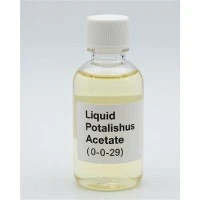
High-Concentration Liquid Potassium Phosphite provides highly soluble potassium and phosphorus (in phosphite form) tailored for agricultural input manufacturers, fertilizer formulators, distributors, and bulk importers.
|
|
|
|
|
|
||
|
|
||
|
|
Potassium (K2O) & Phosphite (P2O5 eq.) |
Phosphorus present exclusively as phosphite (PO3) |
|
|
0-28-26, 0-40-20, or custom solutions |
|
|
Potassium Content (K2O) |
20% - 30% w/v (or 15% - 22% w/w) |
|
|
Phosphite Content (P2O5 Eq.) |
25% - 40% w/v (or 18% - 30% w/w) |
Measured as P2O5 equivalent |
|
|
100% fully miscible |
|
|
PH (1% Solution) |
6.5 - 7.5 |
|
|
Density (20 deg C) |
1.40 - 1.55 g/cm3 |
Crucial for volume-to-mass conversions |
|
|
Less than 0.1% |
|
|
|
Pb < 10 ppm, As < 5 ppm, Cd < 5 ppm |
|
|
|
200L Drums, 1000L IBC Totes, Flexitanks |
Phosphite phosphorus is evaluated under distinct technical standards.
Phosphites require specific pH balancing and compatibility testing during blending.
Many jurisdictions enforce distinct registration routes for phosphite-containing inputs.
Higher active concentrations reduce shipment volumes, directly lowering freight costs per unit of active nutrient, container utilization fees, and packaging overhead.
B2B buyers should evaluate quotations based on the cost per kilogram of active nutrients (K2O + active Phosphite) rather than total liquid weight.
Suitable as a concentrated raw material for secondary liquid blending, high-volume foliar programs, and automated drip irrigation.
Fully soluble for rapid tank mixing. Perform a jar test before blending with secondary micronutrients or crop protection products.
<0.1%) protects irrigation equipment from emitter blockage and scale accumulation.
Functions as a stable potassium and phosphite source in liquid fertilizer manufacturing.
Declared nutrient limits with clear units of measure (% w/w or % w/v).
Verified density range, solution pH, and maximum insoluble limits.
Updated Safety Data Sheet (SDS) and storage compatibility guidelines.
Representative Certificate of Analysis (CoA) linked to specific production batches.
Compliance documentation tailored to destination markets (e.g., Regulation (EU) 2019/1009 regarding phosphonates in European markets).
A: To convert weight percentage to volume percentage, multiply the weight percentage by the liquid density (e.g., 20% w/w multiplied by a density of 1.45 g/cm3 equals 29% w/v). Always confirm which unit convention your supplier uses before comparing commercial quotes.
A: No. Phosphite (PO3) and phosphate (PO4) have different chemical structures and metabolic characteristics. Replacing phosphate with phosphite will alter the chemical dynamics, target performance, and regulatory status of your final product.
A: Liquid fertilizers are frequently purchased by weight (metric tons) but metered or applied by volume (liters). An accurate density measurement allows precise calculation of active nutrient delivery, dosing rates, tank capacity planning, and shipping payload limits.
Q: What compatibility precautions should be taken before tank-mixing?
A: Although highly soluble, concentrated potassium phosphite should be tested prior to large-scale blending. Always conduct a standard jar test with target water, fertilizers, and active inputs to verify that no precipitation, phase separation, or temperature spikes occur.
A: When stored in original, sealed containers at temperatures between 5 deg C and 35 deg C away from direct sunlight, the product maintains stability for up to 24 months. Prevent freezing conditions to avoid potential crystallization.
Népszerű tags: high-concentration liquid potassium phosphite, China high-concentration liquid potassium phosphite manufacturers, suppliers, factory, Kálium-tiocianát